
Seed and mulch for southeast Michigan clay
Hydroseeding in Detroit, MI
New lawns, slope cover and site stabilization, timed to a 180-day growing season.
- No-charge site visit and an itemized quote
- Seed mixes picked for sun, shade and heavy clay
- Silt fence and stabilization set up to match your SESC permit
Why Hydroseed Works on Detroit Ground
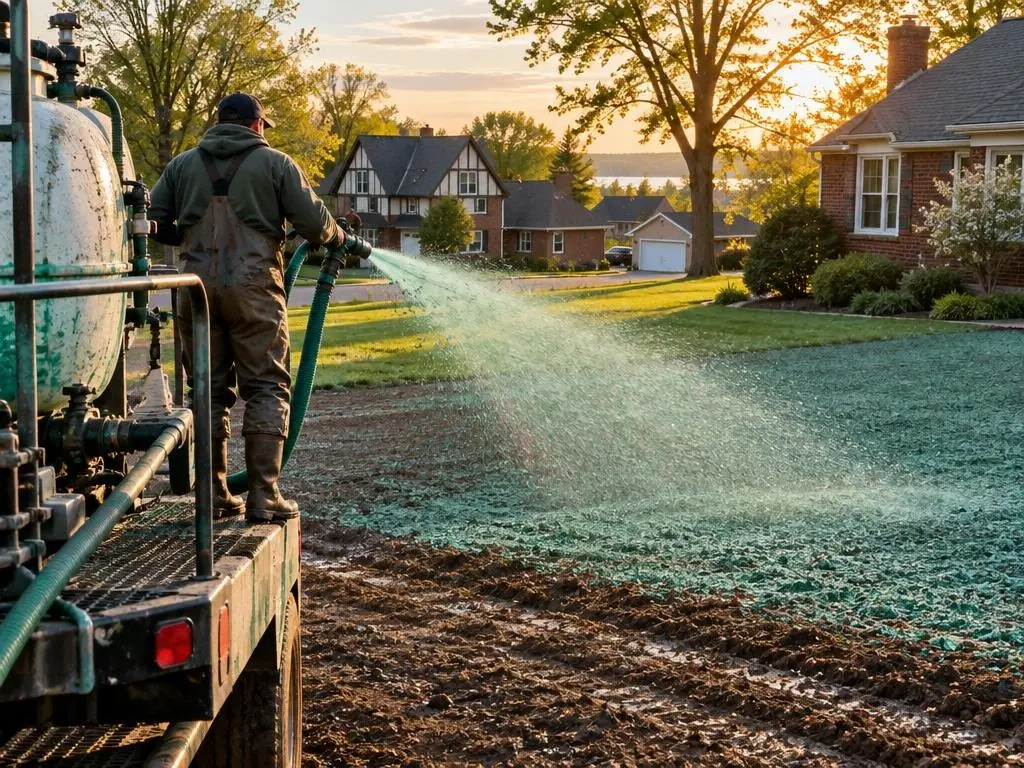
Hydroseeding in Detroit means spraying a slurry of grass seed, wood or paper mulch, starter fertilizer, a tackifier that glues the mix to the soil, and water across prepared ground in one pass. The mulch layer keeps the seed damp and anchored so rain does not carry it off, which matters a great deal here. The city slopes gently from northwest to southeast on a till plain composed largely of glacial and lake clay, and clay that has been scraped bare by construction is one of the hardest surfaces to start grass on. As a hydroseeding company working the city and its suburbs, most of our job is getting that ground ready so the seed has somewhere to root.
What the clay does
The USDA's description of Blount, a clay-rich soil mapped on till plains in Michigan and neighboring states, gives a good picture of what many local yards are dealing with: somewhat poorly drained, a particle-size control section that averages 35 to 45 percent clay, slow permeability, and a perched seasonal water table 0.5 to 2 feet below the surface in normal years. Not every Detroit yard sits on Blount, and plenty of city lots are fill, but the behavior is familiar. Water stands after storms, the subsoil turns to a sticky paste when it is worked wet, and a bulldozer or concrete truck leaves it packed hard. Seed thrown on that surface either rots in a puddle or dries out on a crust. So before we spray, we loosen compacted ground, add screened topsoil where the surface is bare subsoil, and fine grade so the yard sheds runoff away from the foundation and toward the street or a swale.
Seeding windows for a cool-season lawn
Around Detroit, lawns are built from cool-season species, chiefly Kentucky bluegrass, perennial ryegrass and the fescues. The airport's 1991 to 2020 normals put the average freeze window at October 20 through April 22, a growing season of about 180 days, and the city and close-in suburbs fall in USDA hardiness zone 6b, with outer northern and western suburbs in 6a. Our first choice for new seed is late summer into early fall. Extension guidance from Iowa State, a similar cool-season climate, names mid-August to mid-September as the best time to establish a lawn from seed, and that lines up with what we see: warm soil for fast germination, cooler air, and fewer weeds competing. Spring is the second window, once the ground has dried enough to grade. It works, but May and June are the wettest months on the Detroit record, so fresh grade needs more mulch and closer watching. Midsummer seeding is possible with steady irrigation. Late October and later is a gamble with frost.
Sod, hydroseed or dry seed
People ask us to compare the three all the time. Sod looks finished the afternoon it is laid, and it is the right call for a small front yard that has to look done for a closing or an open house, but it is the most expensive option per square foot. Dry seed spread by hand or a broadcast spreader is the cheapest, yet on clay without mulch it is easily washed into low spots and picked over by birds. Hydroseed sits between them on price. University of Nebraska Extension places its cost somewhat above dry seeding and generally below sodding. The same extension source says it also sprouts sooner, with green typically visible within 5 to 7 days when weather cooperates, where dry seed usually needs two to three weeks. For a new-construction lot, a cleared parcel or any yard bigger than a few thousand square feet, hydroseeding usually gives the best balance of cost, coverage and erosion protection.
Rules that come with bare ground
Once soil is disturbed, Michigan's Part 91 rules apply. The state says a soil erosion and sedimentation control permit is generally required for earth changes of one acre or more, or for work within 500 feet of a lake or stream. In Wayne County, the county is the enforcing agency for 35 communities and requires the permit before any earthwork begins on qualifying sites, including those within 500 feet of an open channel drain. Oakland County's program sets a lower trigger near water: more than 225 square feet within 500 feet of a lake, stream, wetland or drain. Its homeowner guidance asks that silt fence stay up until grass is established, and it treats permanent vegetation as 90 percent growth and 1 inch tall across the disturbed area. That is why our erosion control services, silt fence installation and seeding are planned together: the permit does not close until the grass is up.
Big lots and open city parcels
A 2009 parcel survey found about a quarter of Detroit's residential lots undeveloped or vacant. Side lots bought from the city, parcels being cleared for new homes and infill builders' sites all need the same thing: an even, mowable stand of grass that holds the soil. Hydroseeding covers that kind of open ground quickly, and we can mix a lower-maintenance blend for lots that will be mowed only occasionally.
How a job runs
- Site visit: soil, grade, shade, water access and drainage
- Written estimate with prep, topsoil, grading, seed and any erosion controls priced separately
- Rough and fine grading, with topsoil where the surface is bare clay or fill
- Silt fence, blankets or inlet protection where the slope or permit calls for it
- Hydroseeding with seed, mulch, fertilizer and tackifier in one spray
- Written watering plan and a check on germination
After the spray
New seed needs steady moisture, not floods. University of Nebraska Extension advises watering a minimum of two to three times daily when the weather is warm, and Iowa State recommends light waterings that continue for about three weeks after seeding. On clay, short cycles work better than long ones because the surface seals and the rest runs off. Expect the first mowing roughly 4 to 6 weeks after seeding. Keep foot traffic, pets and equipment off until then. If a thunderstorm opens a rill on a slope, call us; patching a spot early is much easier than reseeding a wash later.
Why Homeowners Call Hydroseeding Detroit
Prep before seed
We loosen compacted clay, add topsoil where the surface is subsoil or fill, and grade for drainage before anything is sprayed.
Itemized written estimates
Grading, topsoil, seed, mulch and erosion controls are listed and priced one by one, never rolled into a single lump sum.
Seeding on a Michigan calendar
We tell you plainly when a date is risky, whether it is the wet weeks of late spring or the approach of October frost.
Erosion work tied to the permit
Silt fence, inlet protection and blankets are placed to match the SESC plan for your site, and we seed so the permit can close.
Common Questions
What is the average cost of hydroseeding per square foot?
There is no single national number, only ranges. HomeGuide pegs it at $0.12 to $0.35 per square foot, Angi says most pros charge $0.07 to $0.26, and LawnStarter reports $0.07 to $0.21. Prep work, topsoil and slopes are extra, and the quote we hand you after measuring is the amount you pay.
Is lawn hydroseeding expensive?
It usually costs more than spreading dry seed and much less than sod. In HomeGuide's numbers, sod comes to $1 to $4 per square foot and hydroseeding to $0.12 to $0.35. Expect a minimum charge as well: HomeGuide says contractors commonly set one at $300 to $500 or more.
Can I put grass seed down right now in Michigan?
It depends on the month. Late August through September is the most reliable window around Detroit, and spring works once the ground is dry enough to grade. After mid-October the average first freeze is close, and in midsummer new seed needs daily watering to survive.
Which grass seed works for overseeding in Michigan?
Cool-season blends. Kentucky bluegrass and perennial ryegrass suit sunny lawns, fine fescues handle shade, and tall fescue holds up to wear and dry spells. We match the blend to how much sun the yard gets and how it is used.
How long before a hydroseeded lawn looks green?
In good conditions, seedlings typically show in 5 to 7 days and the lawn fills in over the next several weeks. The first mowing usually comes at about 4 to 6 weeks.
Does hydroseed work on clay soil?
Yes, if the clay is prepared. Packed clay must be loosened, bare subsoil needs topsoil, and the grade must shed water. The mulch in the slurry keeps the surface from crusting while seed germinates.
Do I need a permit to hydroseed my yard?
Seeding an ordinary yard does not need one. Permits come into play when earth changes cover an acre or more, or when work is close to a lake, stream, drain or wetland, and the trigger varies by county. We can help you check which office covers your address.
Our Services
Six kinds of work, from bare clay to established grass, for homeowners, builders and site contractors.
New Lawn Hydroseeding
Hydroseed lawns for new homes, cleared lots and full yard renovations, on prepared and graded soil.
Learn more →Builder & Site Hydroseeding
Large-area hydroseeding for builders, developers, municipalities and site contractors, including permit stabilization.
Learn more →Slope & Erosion Control
Pinned straw or coir blankets, heavy hydromulch and bonded fiber matrix for Detroit-area slopes, swales, ditches and shorelines.
Learn more →Silt Fence & Inlet Protection
Silt fence put in and maintained, plus inlet protection and sediment control, for builders and permitted sites until the grass is up.
Learn more →Fine Grading & Topsoil
Yard grading, topsoil and dirt work that fixes drainage and sets up a lawn before seeding.
Learn more →Lawn Repair & Overseeding
Lawn renovation, bare-spot repair and overseeding for thin, tired or damaged Detroit-area lawns.
Learn more →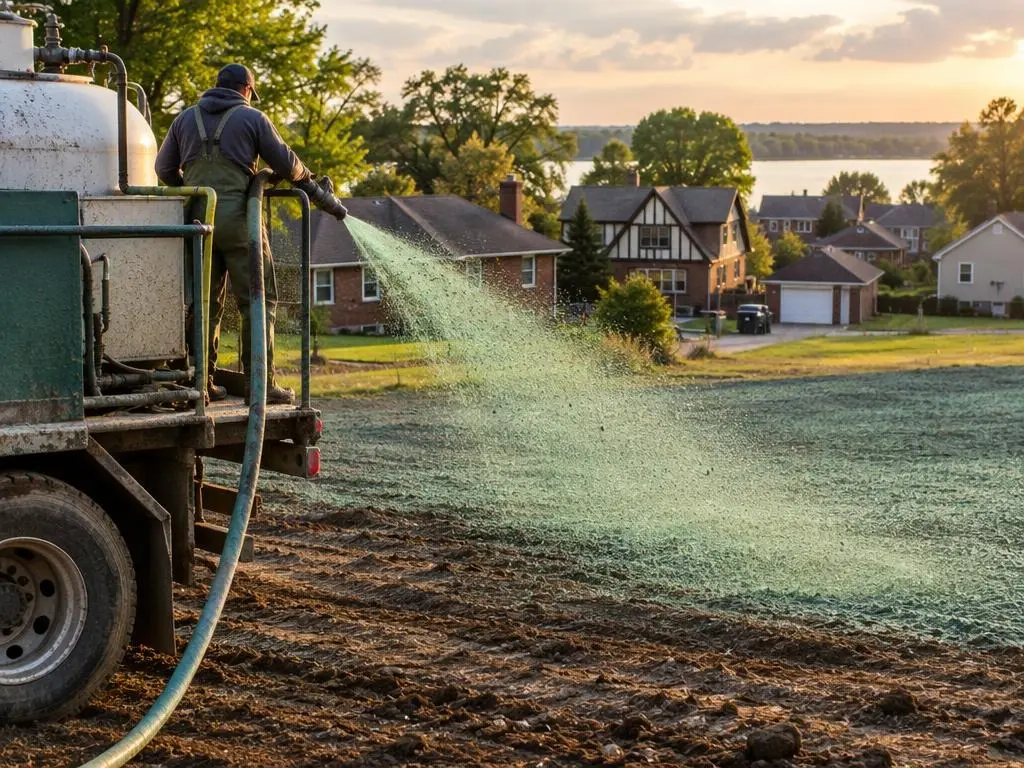
Neighborhoods, Suburbs and Townships We Cover
We work in Detroit and across Wayne, Oakland and Macomb counties, plus Grosse Ile and Brownstown Township downriver. The ground changes a lot over that distance. In the city and inner suburbs like Livonia, it is mostly flat clay and older lawns that need renovation. Canton, Novi, Northville Township, Lyon Township and Macomb Township keep adding new subdivisions, so new-lawn and builder seeding is most of the work. Troy, Sterling Heights, Clinton Township and Shelby Township mix mid-century neighborhoods with river corridors along the Clinton River. North and west, Rochester Hills, Farmington Hills, Independence Township, Orion Township, White Lake Township, Commerce Township and West Bloomfield bring hills, lakes and shoreline lots where slope stabilization matters. Washington Township has larger rural parcels, and Chesterfield Township sits low beside Lake St. Clair. Open a town below for its own soil, water and permit details.
- Hydroseeding in Detroit, MI
- Hydroseeding in Novi, MI
- Hydroseeding in Canton, MI
- Hydroseeding in Troy, MI
- Hydroseeding in Rochester Hills, MI
- Hydroseeding in Sterling Heights, MI
- Hydroseeding in Macomb Township, MI
- Hydroseeding in Shelby Township, MI
- Hydroseeding in Independence Township, MI
- Hydroseeding in Orion Township, MI
- Hydroseeding in Commerce Township, MI
- Hydroseeding in West Bloomfield, MI
- Hydroseeding in Livonia, MI
- Hydroseeding in Farmington Hills, MI
- Hydroseeding in Northville Township, MI
- Hydroseeding in Chesterfield Township, MI
- Hydroseeding in Clinton Township, MI
- Hydroseeding in Washington Township, MI
- Hydroseeding in Lyon Township, MI
- Hydroseeding in White Lake Township, MI
- Hydroseeding in Brownstown Township, MI
- Hydroseeding in Grosse Ile, MI
Book a Free Site Visit
Tell us about the yard, lot or slope. We will look at the soil and give you a written number.